
You've measured the path, the patio, or the driveway, and the quarry sells by the ton. Now you need to answer one question: how much area does a ton of gravel cover? Get it right and you order enough without paying for a pile you don't need.
There's no single answer, because it depends on how deep you spread it and how heavy your stone is. But the math is simple once you see it. This DOTDAY guide shows the formula, the assumptions behind it, a coverage chart, and worked examples you can check yourself.
DOTDAY sells the fabric that goes under gravel, not the gravel itself, so we'll also cover how to size that layer.
The formula
Gravel is sold by weight, but it covers area by volume. To go from tons to square feet, you need two numbers:
- Depth: how thick you'll spread it, in inches.
- Density: how much a cubic yard of your stone weighs, in tons per cubic yard.
Then:
- Cubic yards per ton = 1 ÷ density
- Cubic feet per ton = 27 ÷ density (a cubic yard is 27 cubic feet)
- Square feet per ton = cubic feet per ton ÷ (depth in inches ÷ 12)
Put together: square feet per ton = 324 ÷ (density × depth in inches).
The key assumption: density
Density is the number that changes the answer most. It depends on the stone type, size, shape, and how wet it is. Many suppliers estimate common gravels at roughly 1.3 to 1.5 tons per cubic yard, but that's a general range, not a rule.
Ask your supplier for the weight per cubic yard of the exact material you're buying. Then plug it into the formula. The chart below uses 1.3, 1.4, and 1.5 only to show how much the answer moves.
How much area does a ton of gravel cover? Square feet per ton
Calculated with the formula above and rounded to the nearest square foot.
| Depth | Coverage at ~1.4 tons/cu yd | Range (1.3 to 1.5) |
|---|---|---|
| 2 inches | about 116 sq ft | 108 to 125 sq ft |
| 3 inches | about 77 sq ft | 72 to 83 sq ft |
| 4 inches | about 58 sq ft | 54 to 62 sq ft |
| 6 inches | about 39 sq ft | 36 to 42 sq ft |
Two patterns stand out. Doubling the depth halves the coverage. And heavier stone covers less area per ton.
Why stone type changes the answer
- Pea gravel and river rock: rounded stones that don't lock together. Their weight per yard depends on size and how they settle.
- Crushed stone: angular pieces that pack together, especially once compacted.
- Crushed stone with fines (base material): the fines fill gaps, so it tends to weigh more per yard and compacts tightly.
- Moisture: wet stone weighs more than dry stone, so a ton of wet gravel is less stone.
This is why the supplier's figure for their material beats any general number.
Worked examples
Each example uses an assumed density of 1.4 tons per cubic yard. Swap in your supplier's number.
Garden path: 3 ft by 40 ft, 3 inches deep
- Area: 3 × 40 = 120 sq ft
- Volume: 120 × (3 ÷ 12) = 30 cu ft = 1.11 cu yd
- Weight: 1.11 × 1.4 = about 1.56 tons
Patio: 12 ft by 12 ft, 4 inches deep
- Area: 144 sq ft
- Volume: 144 × (4 ÷ 12) = 48 cu ft = 1.78 cu yd
- Weight: 1.78 × 1.4 = about 2.49 tons
Driveway surface: 10 ft by 60 ft, 4 inches deep
- Area: 600 sq ft
- Volume: 600 × (4 ÷ 12) = 200 cu ft = 7.41 cu yd
- Weight: 7.41 × 1.4 = about 10.37 tons
Driveways are usually built in layers, with a base course and a surface course, so run the math for each layer at the depth your design calls for.
How much is 3 tons of gravel?
At 1.4 tons per cubic yard, 3 tons is 3 × 27 ÷ 1.4 = about 57.9 cubic feet, or about 2.14 cubic yards. Spread 3 inches deep, that covers about 231 square feet.
Our Gravel Calculator runs this math for you.
Don't forget the layer under the stone
Gravel spread directly on soil slowly sinks and mixes with it, especially on paths and driveways that carry traffic. A fabric layer keeps the stone on top, which also means the depth you paid for stays where you put it. Under gravel, that layer is XBAR 5 oz dual-layer fabric.
To size the fabric:
- Measure the area you're covering.
- Add width so the fabric runs up to or under the edging.
- Add seam overlap. Under stone, overlap seams 12 inches or more.
Our Fabric Calculator handles the overlap and roll math.
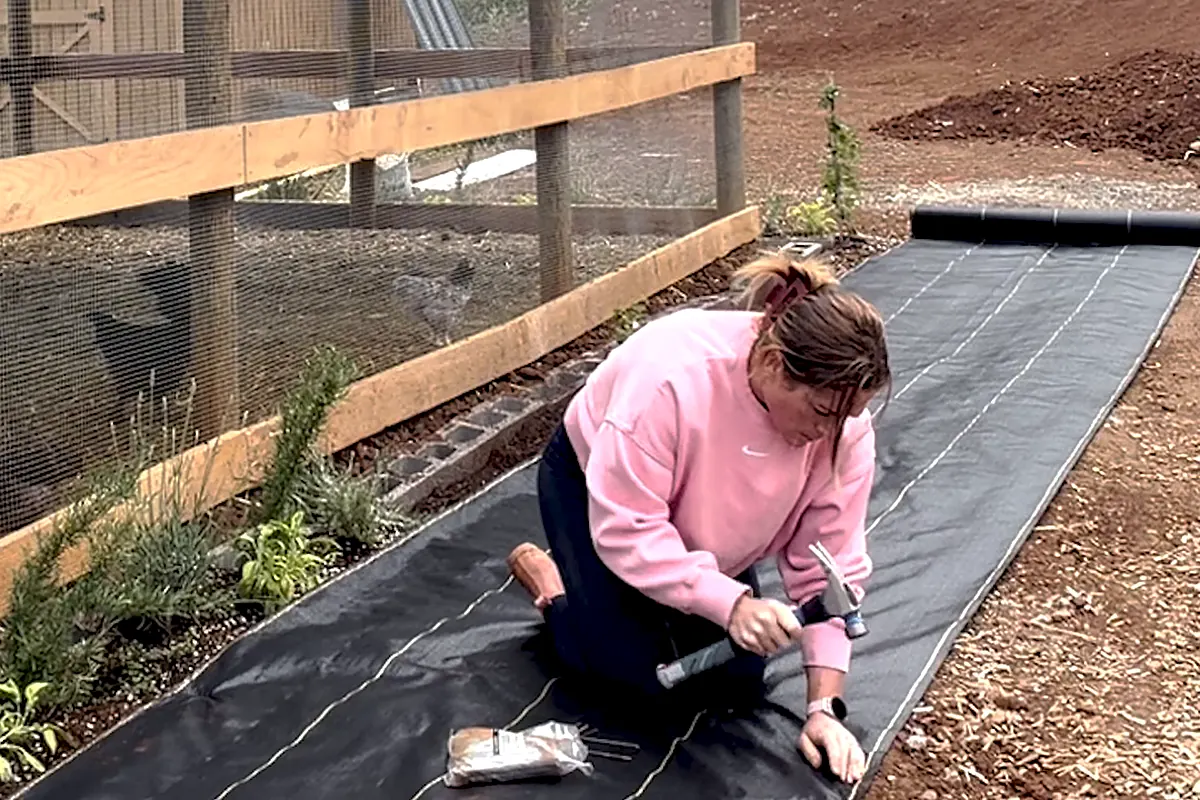
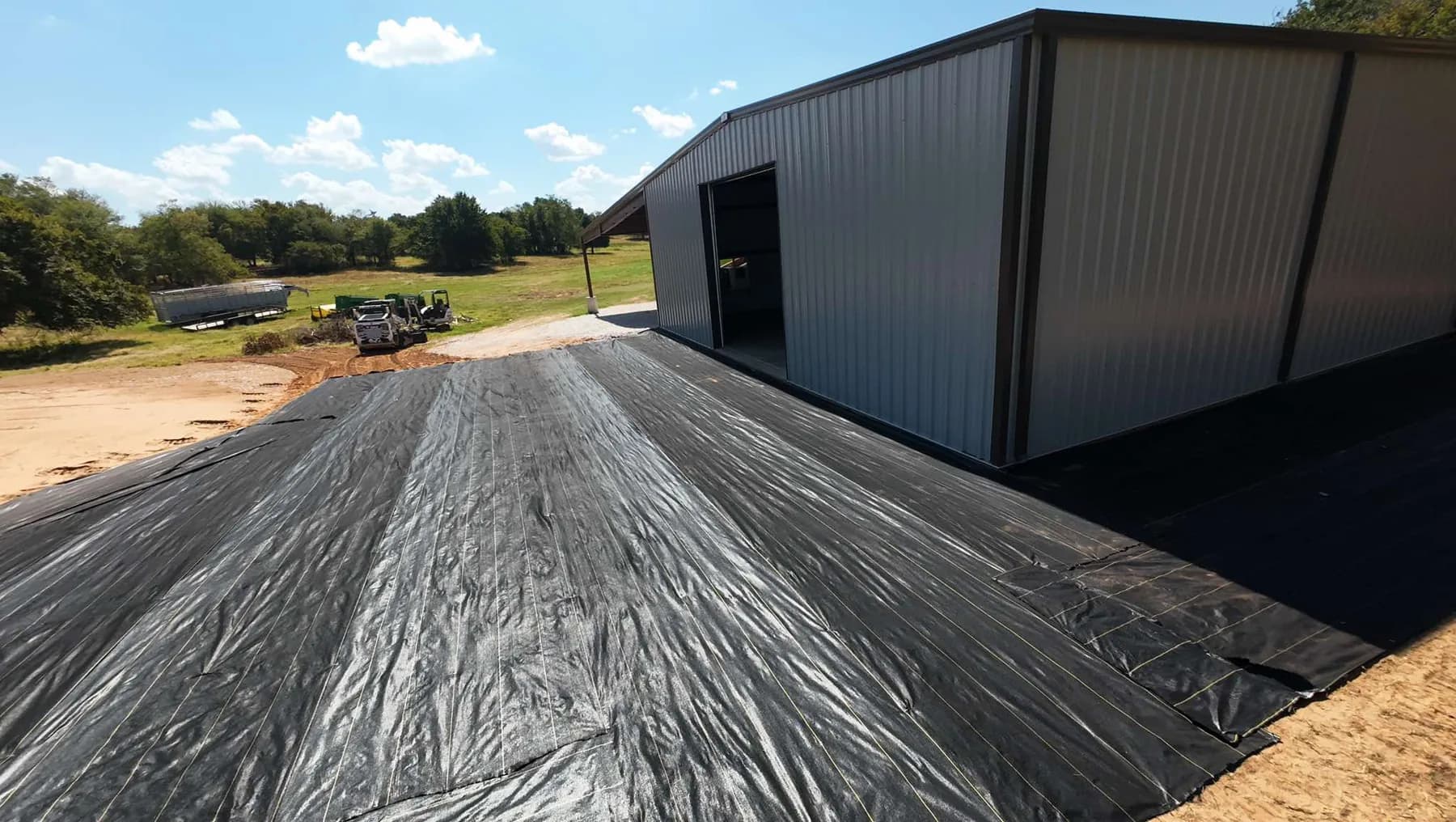
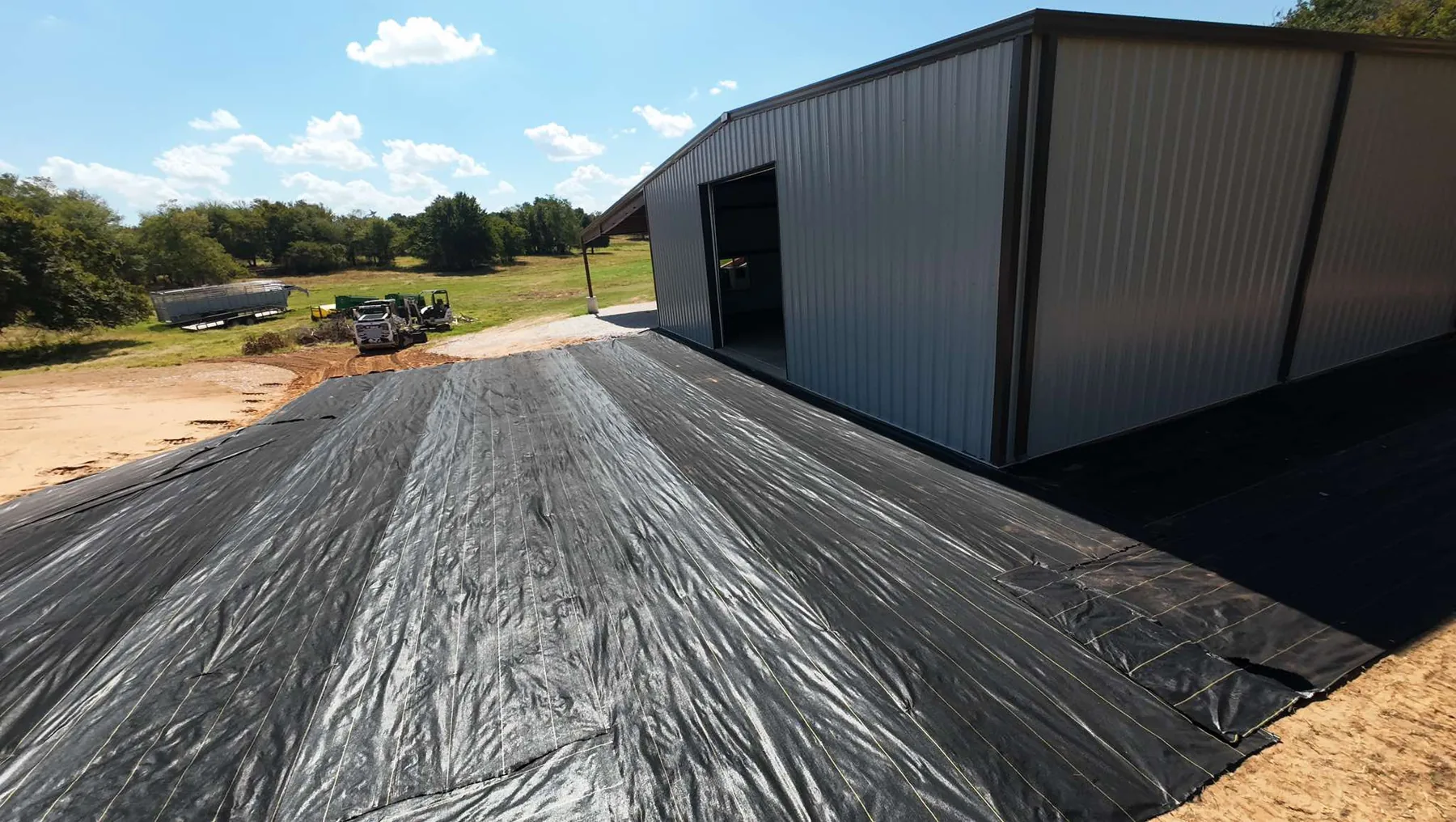
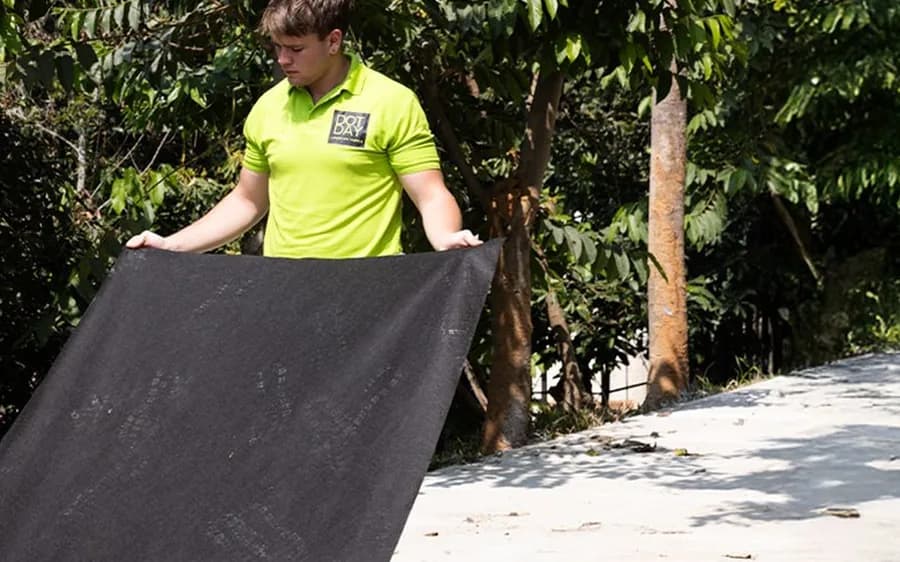
Landscape fabric under gravel: an XBAR driveway install
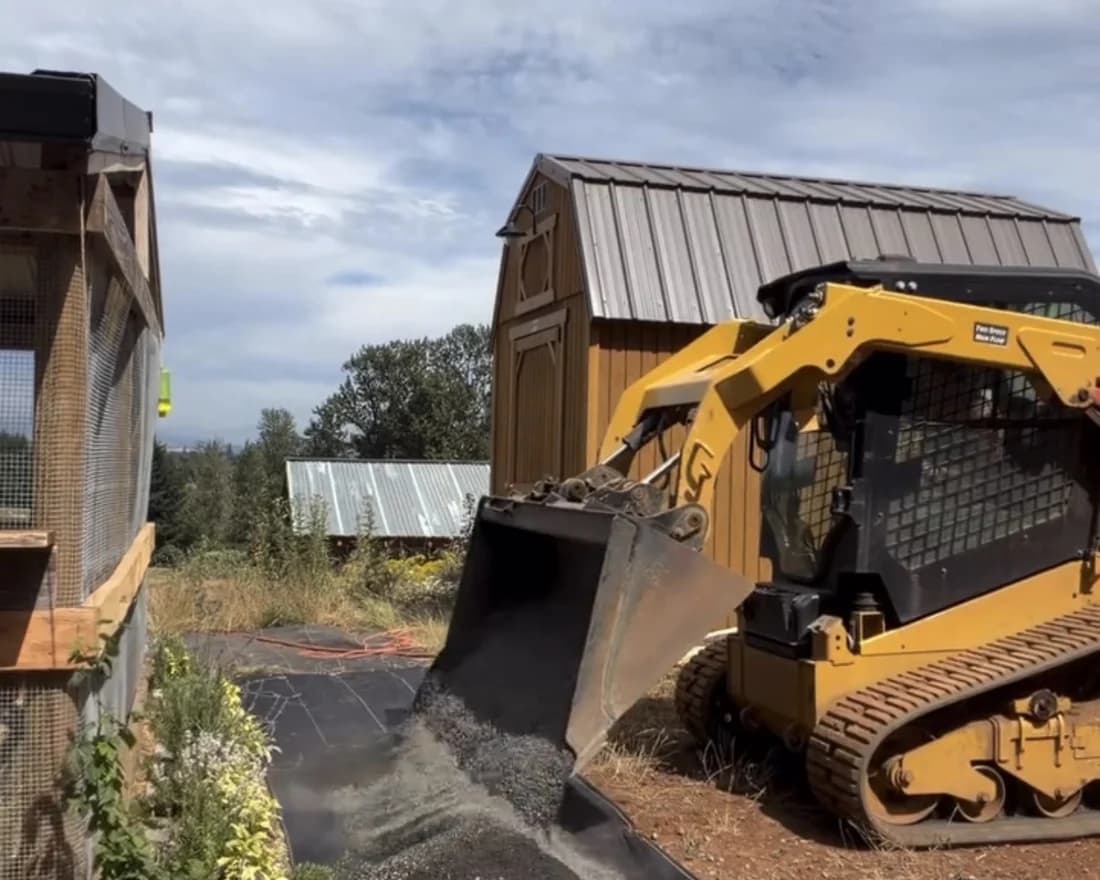
XBAR going down before the stone on a real DOTDAY job.
- Grade and compact the base before the fabric goes down.
- Overlap every seam and pin the edges so stone stays on top.
- Spread the gravel over the fabric instead of driving on it bare.
How much fabric goes under your gravel?
Use the DOTDAY Fabric Calculator to handle the overlap and roll math for your area.
What we recommend
Under gravel paths, patios, and driveways, we recommend XBAR. See how it goes down on real jobs on our driveway fabric page.
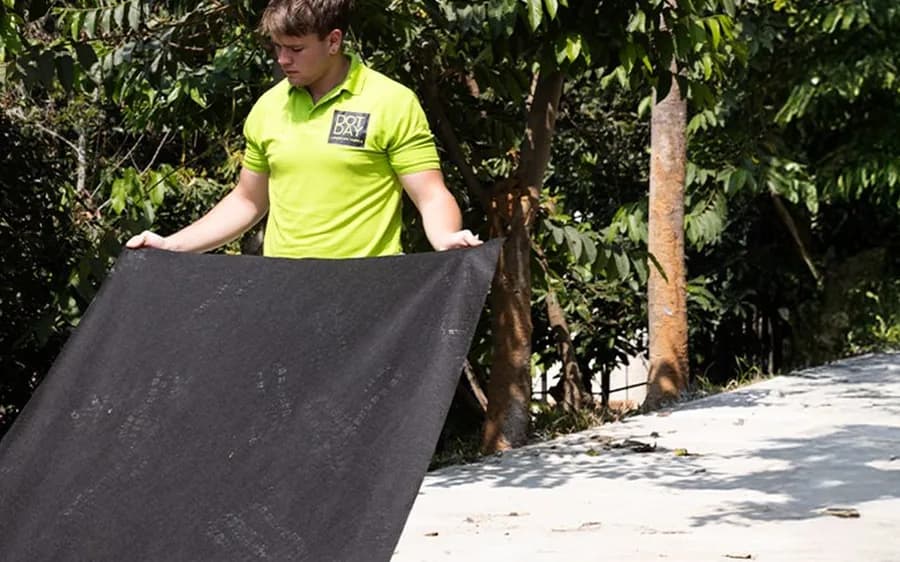
XBAR is our 5 oz dual-layer fabric: a woven top that carries load and suppresses weeds, bonded to a needle-punched non-woven backing that adds bulk and puncture resistance. Printed guide stripes every 12 inches help with straight cuts and even overlaps.
DOTDAY doesn't sell gravel or base stone. Buy it from a local quarry or landscape supplier, and use XBAR as the layer underneath. For the install, see how to install landscape fabric under gravel and our pick of the best landscape fabric for gravel driveways. Ordering by the truckload? Request bulk pricing.
Ordering tips
- Get the density from your supplier before you calculate.
- Ask about compaction. Compacted base takes more material than loose depth suggests, and your supplier can tell you how much extra to plan for with their stone.
- Bulk vs bags. Bagged gravel suits small jobs. For paths, patios, and driveways, bulk delivery is usually simpler.
- Check delivery minimums and where the truck can dump.
Wrapping up
The formula is simple: depth and density decide coverage, so get your supplier's density and run the numbers. DOTDAY XBAR keeps that stone on top once it's down.
Sizing your project? Use the DOTDAY Fabric Calculator to size your fabric, or try the Fabric Finder if you're still choosing one.
XBAR for gravel paths, patios, and driveways
5 oz dual-layer fabric that keeps stone on top of the soil. Check the product page for the sizes in stock today.
Shop XBARThree fabrics. One simple rule.
Use the right fabric for the right ground condition.
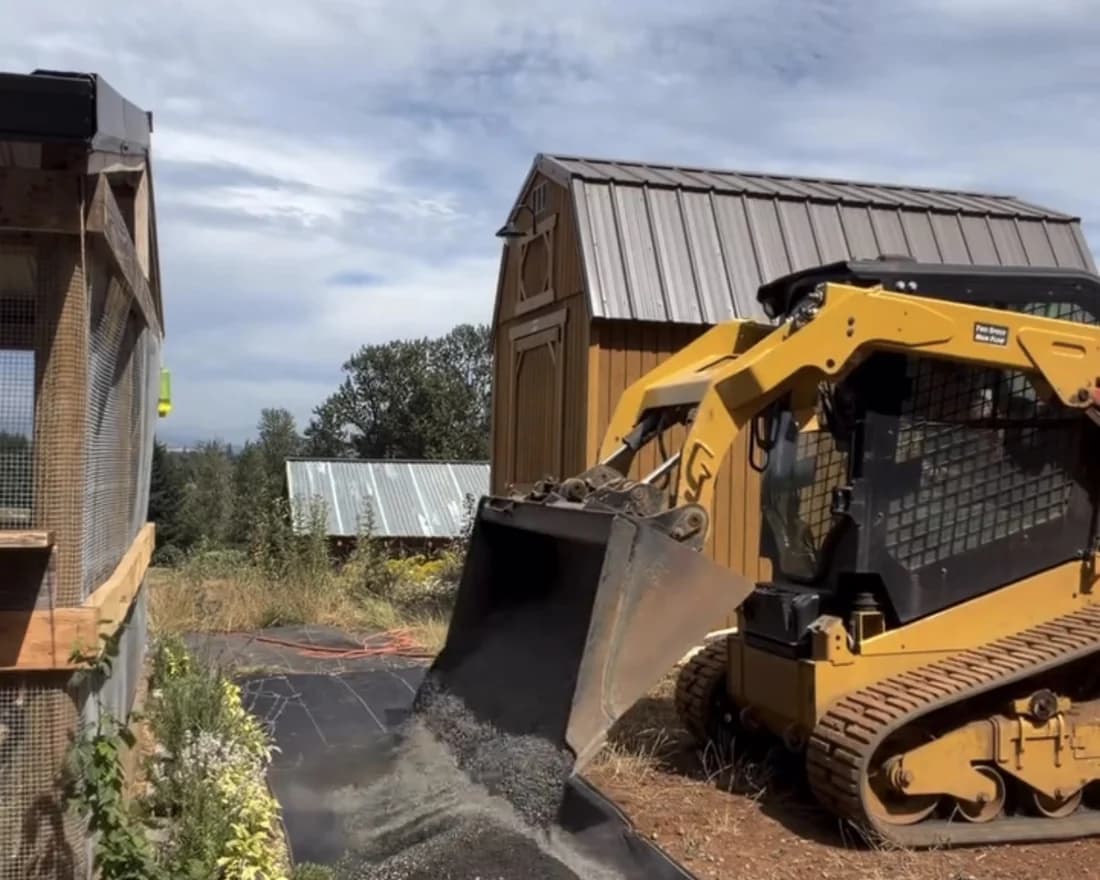
XBAR
Heavy-duty woven hybrid engineered for load and separation under hard surfaces.
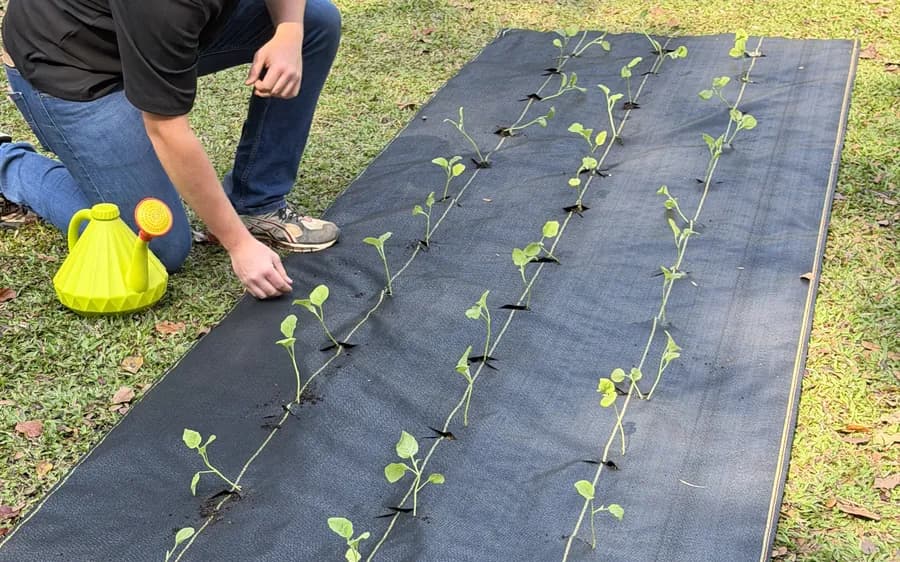
SHIELD
Woven polypropylene weed barrier built to suppress weeds while letting water and air through.
TERRA
Non-woven geotextile designed for drainage, filtration, and soil separation.