|Free Shipping on Orders|Woven & Non-Woven Available|Pro Contractors: Request Bulk Pricing|SHIELD. XBAR. TERRA. One for Every Job
Enter each bed and the depth you want. The mulch calculator returns cubic yards for a bulk order and the number of 2 or 3 cu ft bags for shrub borders, perennial beds, tree rings and paths. Below it: when mulch is worth it, when to skip it, and what works instead. No sign-up.
Free, no sign-up · Bulk yards or bags · Weed barrier and staples included
Add each bed separately. Odd shapes are easiest broken into rectangles.
Coarse bark or wood chips in shrub borders, perennial beds and tree rings.
Optional. Type your local prices to see a cost. Leave them blank for quantities only.
Enter the size of at least one bed and a depth to see cubic yards and bags.
For permanent landscape beds, usually yes. For rows you harvest and replant every season, often no. Here is the honest trade-off.
What a 2 to 3 inch layer does in a landscape bed.
What to plan for so it does not backfire.
The classic job. Plants stay put for years, so mulch works season after season. Lay SHIELD underneath and about 2 in of bark on top is enough, with far fewer weeds coming through.
Use SHIELD plus 2 to 3 in of mulchSpread 2 to 3 in out toward the drip line, and keep it a couple of inches back from the trunk. A volcano piled against bark slowly kills trees.
Use mulch, keep it off the trunkWood chips make good walkways between beds and boxes. They keep boots out of the mud and weeds down, and they never get dug into the growing soil.
Use 3 to 4 in of wood chipsVegetable and cut-flower rows are dug and replanted every season, and wood mulch ends up mixed into the soil. Use SHIELD with planting holes in the row, plus straw only after the soil warms.
Use SHIELD in the rowPaths that carry daily traffic grind wood mulch down fast. For a walkway or patio that stays put, use gravel over XBAR, the 5oz dual-layer fabric built for stone.
Use gravel over XBARLight mulch floats and washes out of swales and drainage lines. Where water needs to move, use stone over TERRA non-woven geotextile.
Use TERRA for drainageMulch is one way to cover soil, not the only one. These cost less to keep up and suit the places mulch struggles.
Low spreading plants such as creeping thyme, sedges or barrenwort fill the gaps between shrubs, shade the soil and crowd out weeds. Once they knit together, there is nothing to top up.
Space perennials so their leaves meet at maturity. A full canopy shades the soil the way mulch does, and leaves little bare ground for weeds.
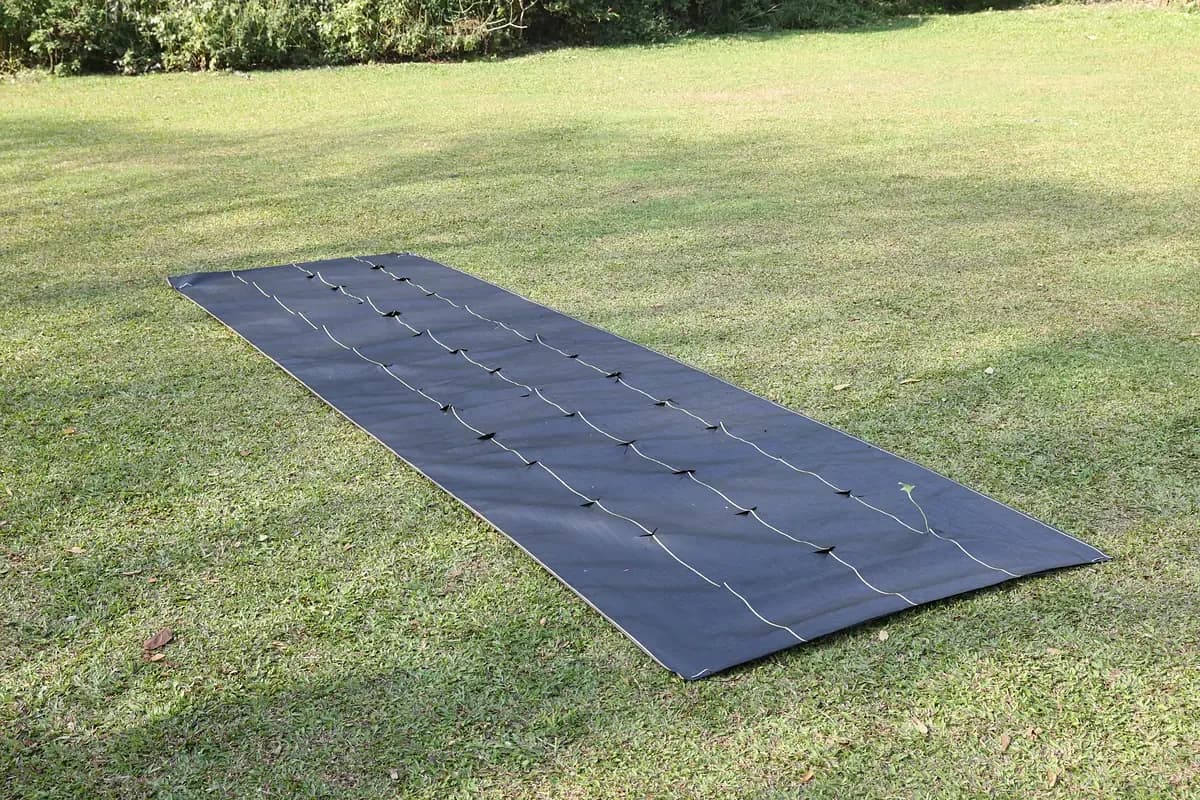
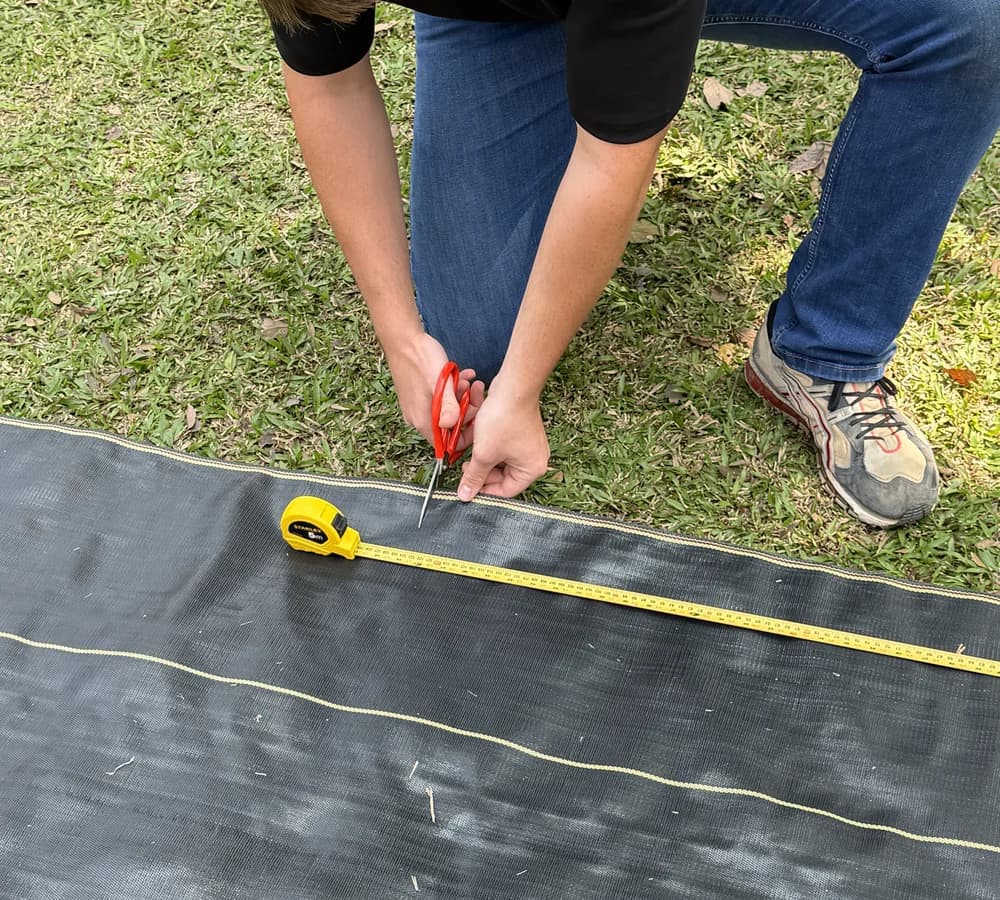
Growers lay woven fabric down the row, burn planting holes, and reuse it for seasons. The fabric does the weed control, so there is no mulch to buy and nothing gets dug into the soil.
If a vegetable row needs cover in summer, spread clean straw or shredded leaves once the soil has warmed. They break down or come off in fall, ahead of next season's planting.
Side yards, utility strips and walkways do not need organic mulch at all. Gravel over XBAR stays put and never needs topping up.
In shrub borders, fallen leaves raked under the shrubs make a free, fine mulch that feeds the soil as it breaks down.
| Depth | Best for | Cubic feet | Cubic yards | 2 cu ft bags | 3 cu ft bags |
|---|---|---|---|---|---|
| 1 in | Topping up an older layer | 8.3 | 0.31 | 5 | 3 |
| 2 in | Fine mulch, or over fabric | 16.7 | 0.62 | 9 | 6 |
| 3 in | Coarse bark in landscape beds | 25 | 0.93 | 13 | 9 |
| 4 in | Wood-chip paths between beds | 33.3 | 1.23 | 17 | 12 |
Mulch shades the surface, but weeds already in the soil push up through it as it thins. SHIELD stops them at the soil. The woven polypropylene blocks light while rain, irrigation and air pass straight through, so the mulch on top only has to cover and protect the fabric. That means a thinner layer, about 2 in, and fewer weeds to pull. Two habits keep it working for years: keep the cover thin, and every couple of seasons rake off the broken-down mulch and refresh it, rather than piling new mulch on top.
Multiply length by width to get square feet, multiply by the depth in inches, and divide by 12 for cubic feet. Divide cubic feet by 27 for cubic yards. The calculator does this for every bed and adds them up.
One cubic yard covers about 324 sq ft at 1 in deep, 162 sq ft at 2 in, 108 sq ft at 3 in, and 81 sq ft at 4 in.
A cubic yard is 27 cubic feet, so it takes 13.5 bags of 2 cu ft, or 9 bags of 3 cu ft.
About 3 in of coarse bark or wood chips, or 2 in of finely shredded mulch. Deeper is not better: too much mulch keeps the soil wet and starves roots of air. Keep it a couple of inches back from trunks and stems.
Not with bark or wood chips in the growing rows, because the beds are dug and replanted every season. Use clean straw or shredded leaves once the soil has warmed, or lay woven fabric down the row and plant through it. Wood chips are fine in the paths between beds.
Often. A living groundcover, closer plant spacing, woven fabric in harvest rows, or stone over fabric where nothing grows all cover the soil without yearly mulch. Mulch is most worth it in shrub borders, perennial beds and tree rings, ideally over a weed barrier.
Yes, where you want fewer weeds and less upkeep. A woven fabric like SHIELD stops weeds coming up from the soil, and the mulch on top only has to cover it, so about 2 in is enough. Keep the mulch thin and refresh it every couple of seasons. In beds where you divide and move perennials often, mulch alone is simpler.
Not when it sits on top. Nitrogen tie-up happens when fresh wood is mixed into the soil, which is why bark does not belong in beds you dig every season.
Landscapers and growers can get fabric for rows, beds and paths on one order. Send the square footage and the job, and we will tell you where fabric earns its place and where it does not.
