|Free Shipping on Orders|Woven & Non-Woven Available|Pro Contractors: Request Bulk Pricing|SHIELD. XBAR. TERRA. One for Every Job
Most calculators give you a volume. This one gives you a job estimate: the tons to order, what the stone costs, the fabric that goes underneath and a total you can quote from.
1 area · 0 sq ft
Add as many separate areas as you need. Odd shapes are easiest broken into rectangles.
Pre-selected for this project. Each material compacts differently, so we apply the right factor rather than a flat waste percentage.
Stone and fabric
Pre-filled with US average stone prices. Put your own yard's price in if you have it.
Depth follows the load the ground has to carry, so the job comes first.
Every big gravel calculator does the same three things: length by width by depth, divide by 27, multiply by a density. Then it tells you to add ten percent.
That ten percent is wrong in both directions. You buy stone loose and install it compacted, and how much it shrinks depends entirely on the stone.
The flat rule leaves you 1.3 tons short.
The flat rule over-orders by 0.1 tons.
Crusher run and road base lose a fifth to a quarter of their loose volume once rolled, because the fines migrate into the voids. Open graded stone like #57 has no fines, so it barely moves.
The calculator asks for the compacted depth you want on site, then works backwards to the loose volume to buy. On this driveway the flat rule is 1.3 tons short on the base alone.
Stone laid on bare soil migrates into the subgrade under load. The fabric quantity belongs on the same materials list, worked out with strip and overlap math rather than a bare square footage.
The bar is how much extra loose stone you buy to end up with the compacted depth you asked for, and the marker is where a flat 10% allowance would put it: short on everything to its right, over on the rest. Density turns that loose volume into a delivery weight. Both vary by quarry, so treat these as sound working figures and confirm with your supplier before ordering by weight.
Every build-up drawn to the same scale, fabric on the subgrade, stone on top. These are the depths the calculator pre-fills when you pick a project.
Foot traffic only. Fabric still stops the stone sinking.
2 to 3 in is plenty. Deeper wastes stone and traps heat against plants.
Extend 12 in past the footprint on all sides.
Smooth rounded stone is kinder on paws.
Screed the sand, do not compact it before laying.
Angular top stone locks together, rounded stone migrates.
Trucks, RVs, trailers and equipment access.
Wrap the stone in non-woven so silt is filtered out.
Compact the base in lifts of no more than two to three inches rather than dumping the full depth and rolling it once, and over excavate by the full finished depth so the gravel sits in the ground rather than proud of it.
Every time a wheel passes, stone is pressed down into the subgrade and soft ground is pumped up between the stones. Within two or three seasons a four inch layer behaves like a two inch layer, ruts form in the wheel tracks, and the usual response is to order another load.
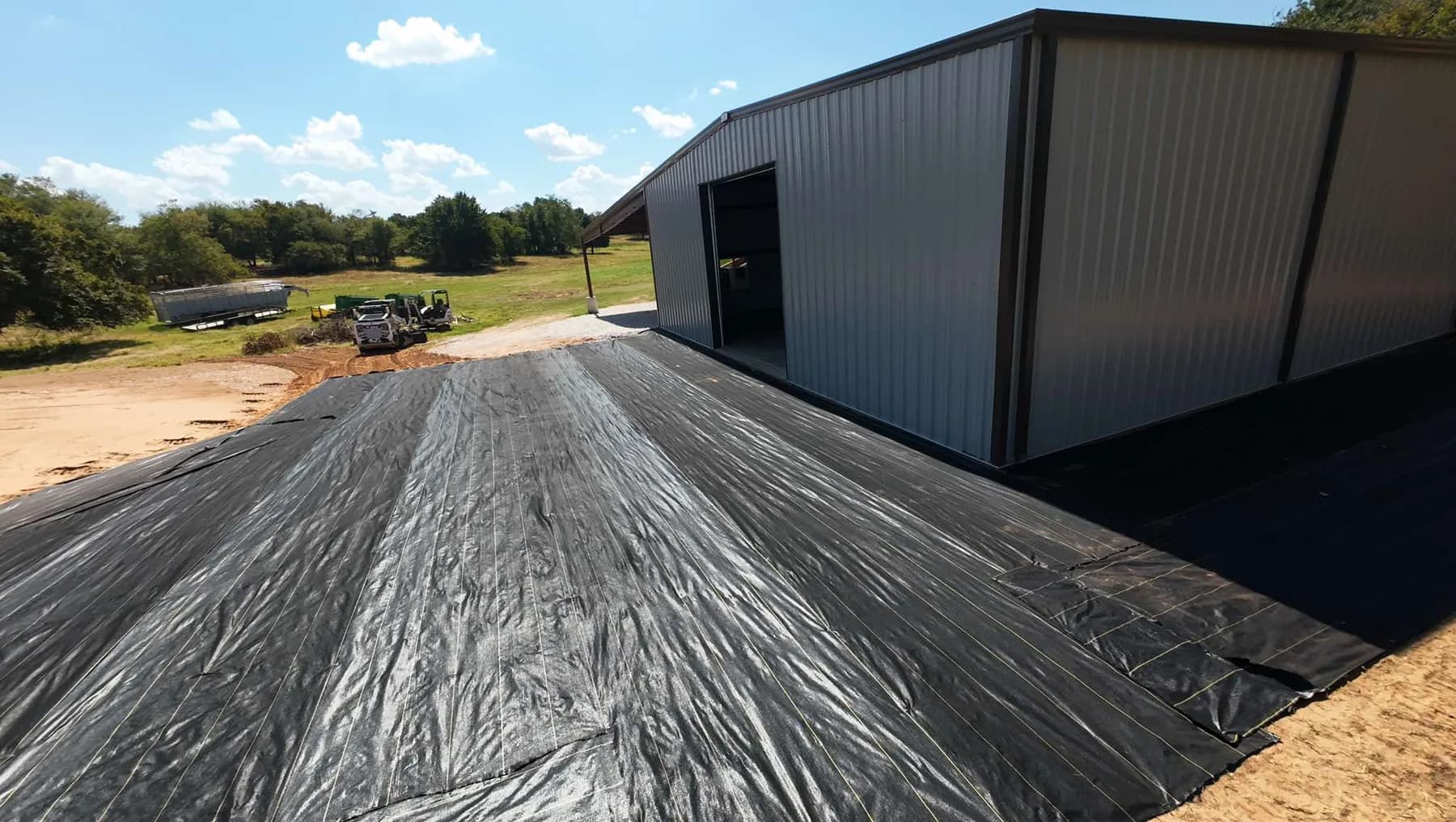
A separation layer between the stone and the soil holds the aggregate in the layer you paid for, spreads the wheel load across a wider footprint of subgrade, and lets water keep draining vertically instead of pooling. A sealed barrier such as plastic sheeting does the opposite: it traps water at the interface and makes the rutting worse.
View XBAR
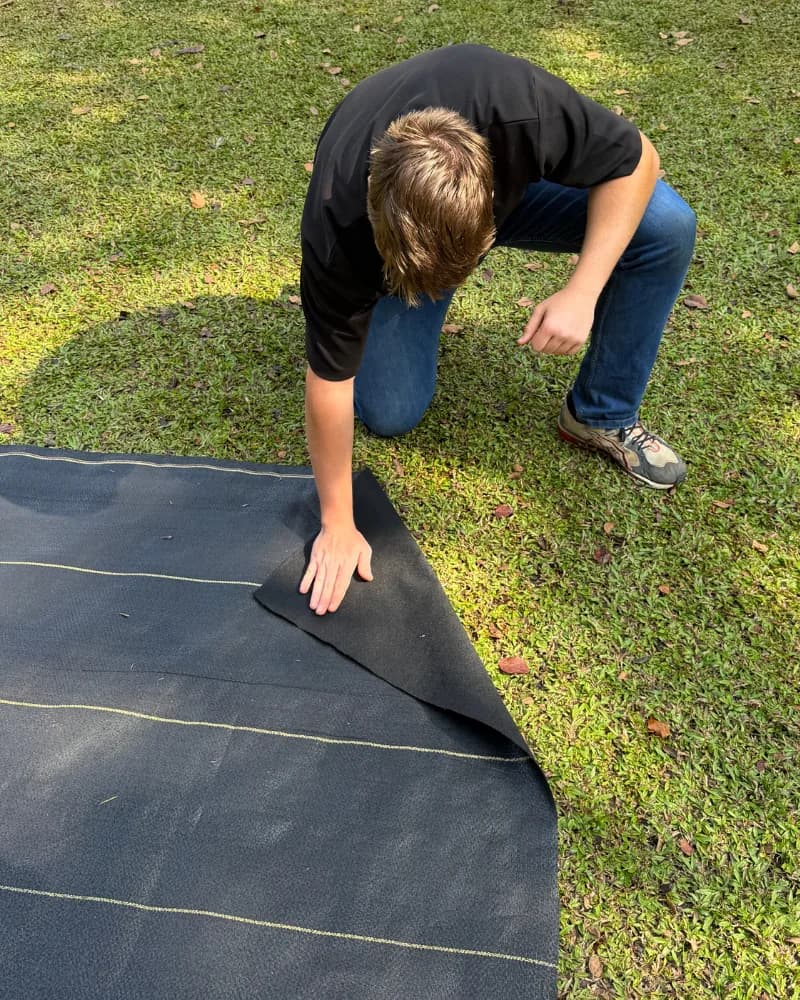
Left: fabric goes down first, base goes straight over it. Jeff St. Pierre, St. Pierre Stone & Garden, working with TERRA on a path build. Right: XBAR 5oz dual-layer needle-punched capped fabric. The woven core carries the load, the capped face sits against the soil.
Three numbers and facts to check before you order.
Whether the fabric survives being dragged across a subgrade and loaded with stone. XBAR is tested at 96 lbs.
Water has to keep moving vertically. XBAR flows at 10.5 gal/min/sf, so the layer drains rather than perching water.
A woven layer carries the load and resists stretch, a needle-punched layer adds bulk against the soil and blocks light. XBAR is a 5oz dual-layer needle-punched capped fabric.
Contractors, landscapers and site crews get direct trade pricing, pallet quantities and freight quotes on XBAR, SHIELD and TERRA. Send the square footage and we will price it.
Contractors roll the fabric first, pin it, overlap the seams, then bring the stone straight over the top. The order never changes, whatever the project.
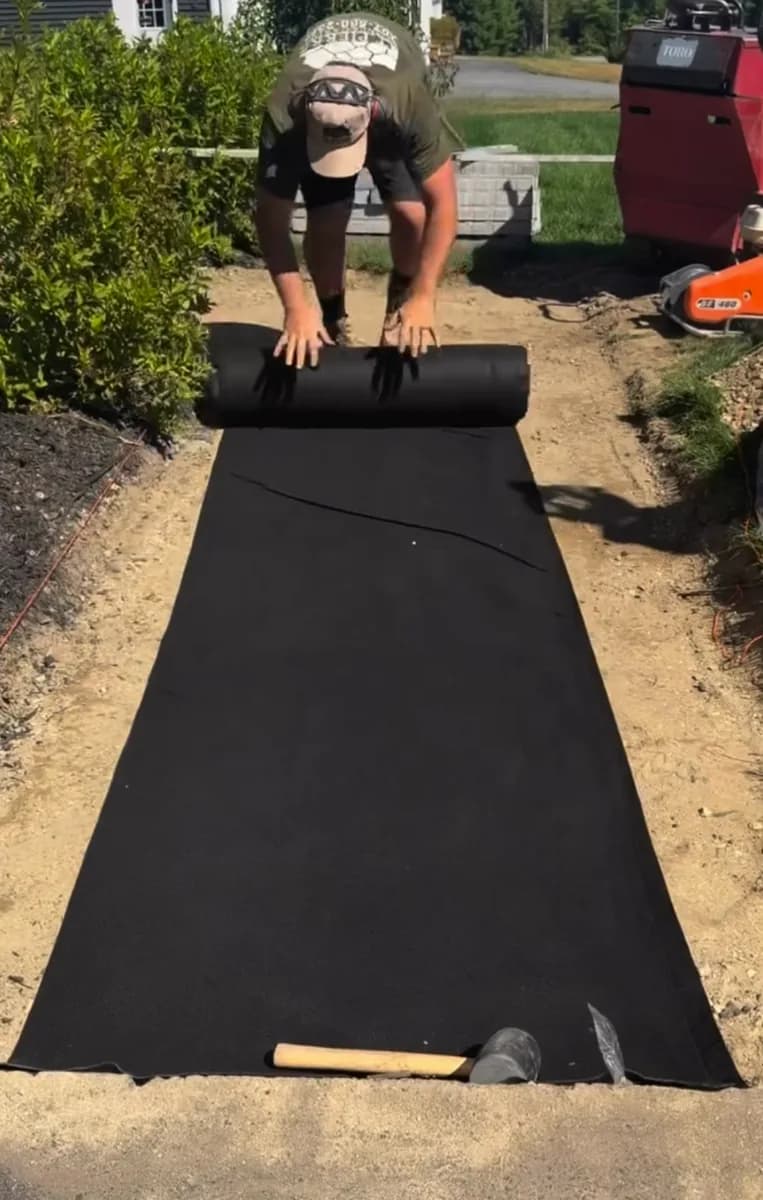
Straight onto the prepared subgrade, guide stripes for overlap
Base material straight over the fabric, no driving on bare cloth

In 2 to 3 inch lifts, not one deep dump
XBAR 5oz
Dual-layer needle-punched capped fabric for driveways, walkways, paver bases and anything carrying a wheel load.
View XBARSHIELD 3.2oz
Woven weed barrier for garden beds, farm rows and raised planters under mulch or light decorative stone.
View SHIELDTERRA 4/6/8oz
Non-woven needle-punched geotextile for French drains, retaining wall backfill and soil separation.
View TERRAA residential gravel driveway needs about 4 inches of compacted base plus 2 to 3 inches of angular top stone. For a 12 ft by 40 ft driveway, which is 480 square feet, with 3 inches of top stone that works out near 7.4 loose cubic yards of crusher run and 4.8 loose cubic yards of #57 once compaction is allowed for, or about 17 tons in total.
Because you buy loose material and install it compacted. Crusher run and road base lose roughly 20 to 25 percent of their loose volume when properly compacted, so a 4 inch compacted layer needs about 5 inches of loose material spread before rolling. Open graded stone such as #57 barely compacts and needs only a few percent extra. A flat 10 percent waste allowance is wrong in both directions.
Most crushed stone falls between 1.30 and 1.45 tons per loose cubic yard when dry. Crusher run and road base sit at the heavier end because the fines pack into the voids. Wet material can run 10 to 15 percent heavier, which matters when buying by weight and paying freight.
Yes for any gravel sitting on soil. Without a separation layer the stone is pressed down into the subgrade under load and soft ground pumps up between the stones. Use XBAR, a 5oz dual-layer needle-punched capped fabric, under load bearing stone and a non-woven geotextile such as TERRA where the job is filtration rather than load spreading.
No. Plastic is impermeable, so water reaching the bottom of the gravel has nowhere to go. It sits at the interface, softens the subgrade and accelerates the rutting you were trying to prevent.
Under everything, directly on the prepared subgrade, because its job is to separate aggregate from soil. On very soft ground some crews add a second layer between base and top stone, but the one doing the structural work is always the bottom one.
Send us the project, the soil and the traffic it has to take. We will tell you which weight to use and what it costs delivered, whether that is one roll or a pallet.


