
Before you dig, most homeowners want a clear french drain installation cost picture: DIY materials versus hiring a crew. Digging is the hard part; slope, outlet, gravel and fabric decide whether it keeps working. This guide covers cost buckets, then how to install a french drain step by step.
At DOTDAY, we're a Houston-based landscape fabric company that ships across the U.S. We make TERRA, the non-woven geotextile that lines French drains. For filter-cloth choice alone, see our French drain fabric guide.
French drain installation cost: DIY materials vs hiring out
Exact dollars swing by length, soil, region and trencher rental. Treat these as buckets, not a fixed quote.
- Labor: DIY is your time (and maybe a trencher rental). Pros cost more up front but finish faster on long or rocky runs.
- Gravel / drain stone: Usually the biggest material line. Size it with the Gravel Calculator.
- Perforated pipe and fittings: Typically 4 inch pipe plus outlet fittings.
- Filter fabric (TERRA): Non-woven geotextile wide enough to line the trench and fold over. Size it with the Fabric Calculator.
Pro installs bundle labor, disposal and often delivery. DIY shifts cost into rentals and your weekend. Skipping fabric to "save money" usually means digging twice when fines clog the gravel.
How a French drain works
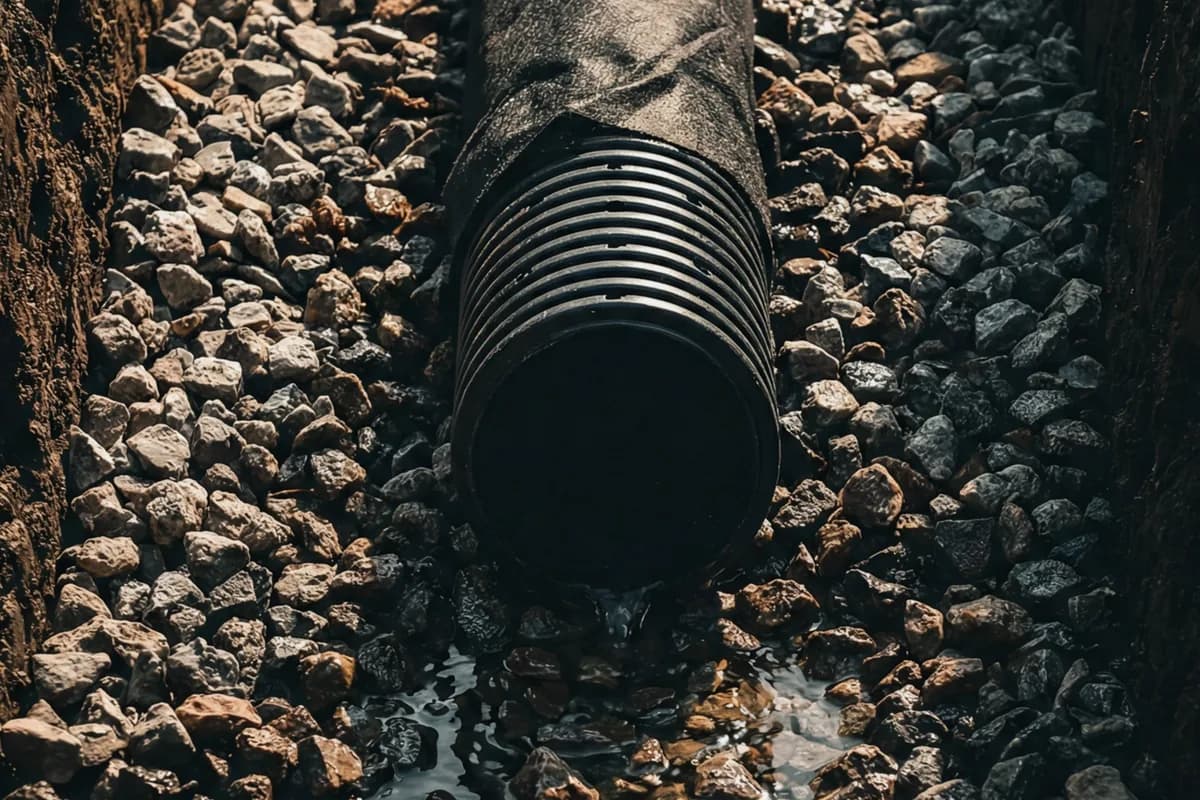
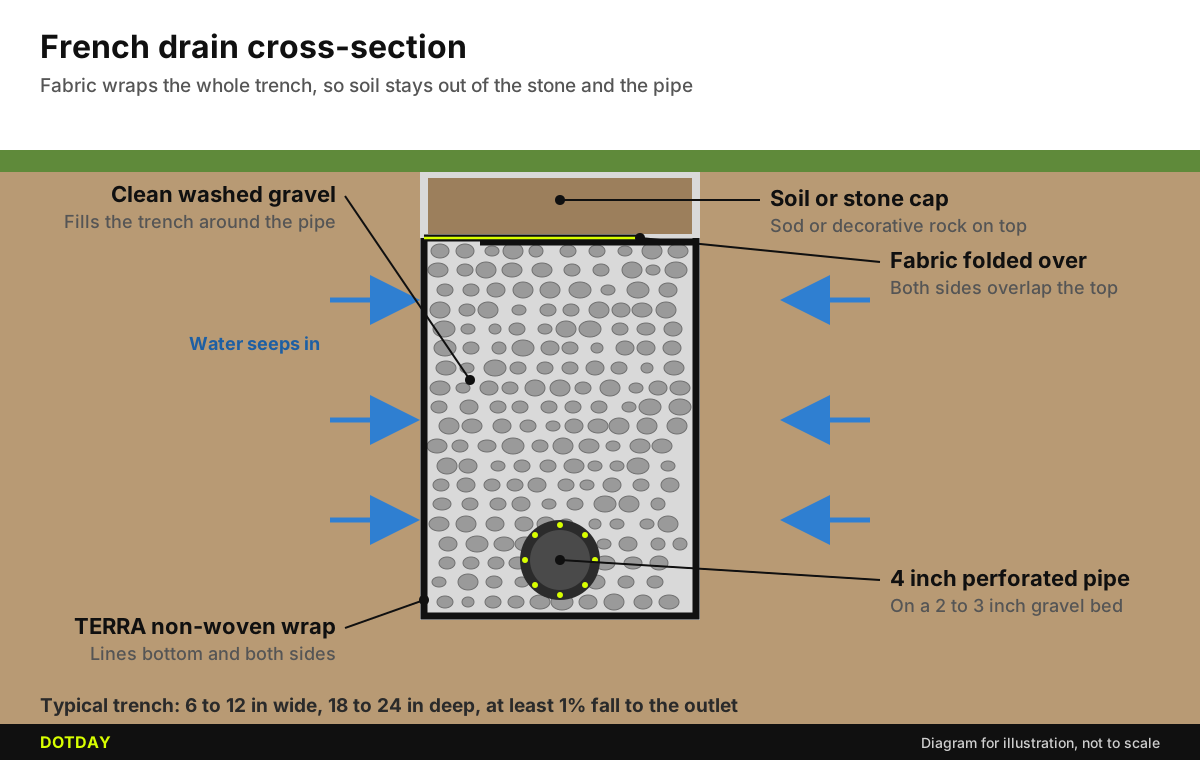
A French drain is a trench filled with clean gravel, usually with a perforated pipe near the bottom. Water seeps into the gravel, finds the pipe, and flows downhill to an outlet. It fails when soil fines wash into the gravel, or when the pipe has no slope or nowhere to go.
What you need before you dig
| Item | What to look for | Where it comes from |
|---|---|---|
| Non-woven geotextile | Wide enough to line the trench and overlap on top | DOTDAY TERRA 4, 6 or 8 oz |
| Drain stone | Clean, washed, angular gravel | Local stone yard |
| Perforated pipe | 4 inch, plus fittings for the outlet | Hardware store |
| Layout tools | String line, line level or laser, stakes | Hardware store |
| Digging tools | Trenching shovel, or a rented trencher for long runs | Rental yard |
Step 1: Plan the route and the outlet
Start at the end. Water needs somewhere safe to go:
- Daylight: the pipe exits at a lower point on your property.
- Dry well: an underground pit that lets water soak in.
- Pop-up emitter: a fitting that releases water at the surface downhill.
Call 811 a few days before you dig so buried utilities get marked.
Step 2: Check the slope
The trench bottom needs a steady fall toward the outlet. A common guideline is at least 1% (about 1 inch of drop for every 8 feet of length), and more is better. Run a string line with a line level, or use a laser level on longer runs.
Step 3: Dig the trench
Most residential trenches run 6 to 12 inches wide and 18 to 24 inches deep. Keep the bottom smooth and follow your slope.
Step 4: Line the trench with geotextile
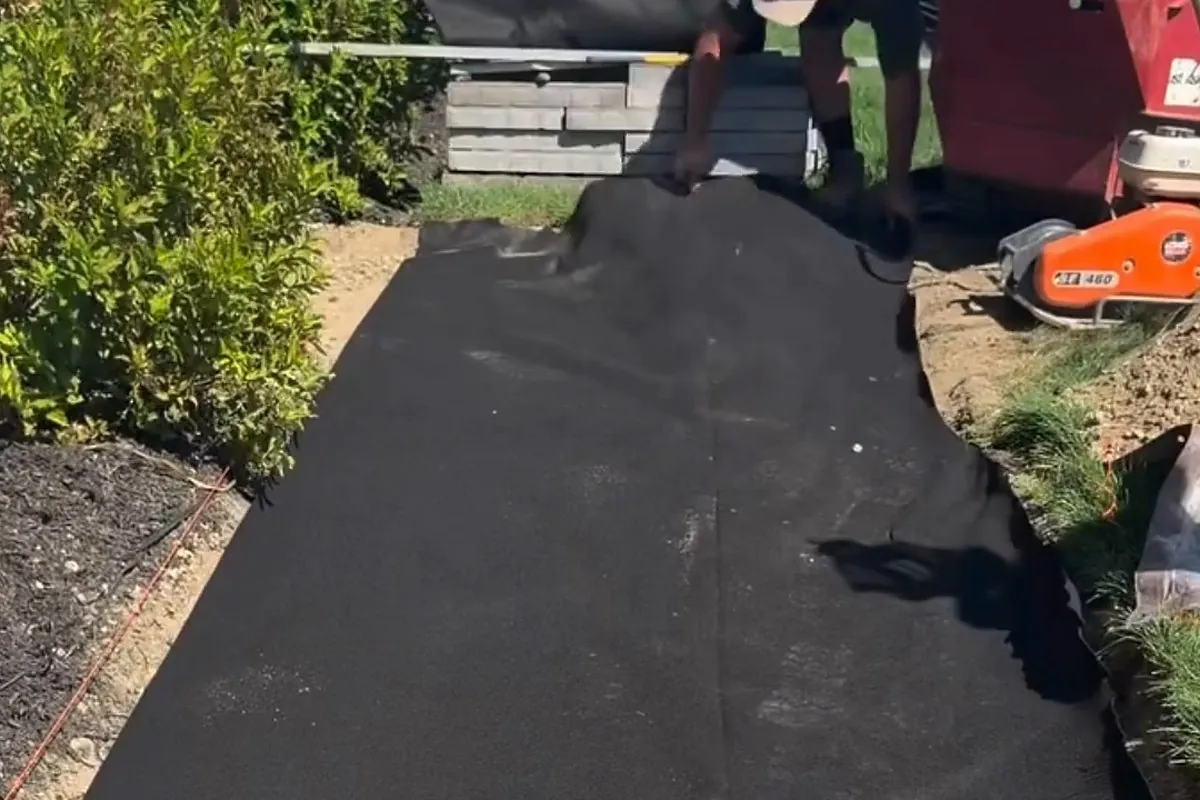
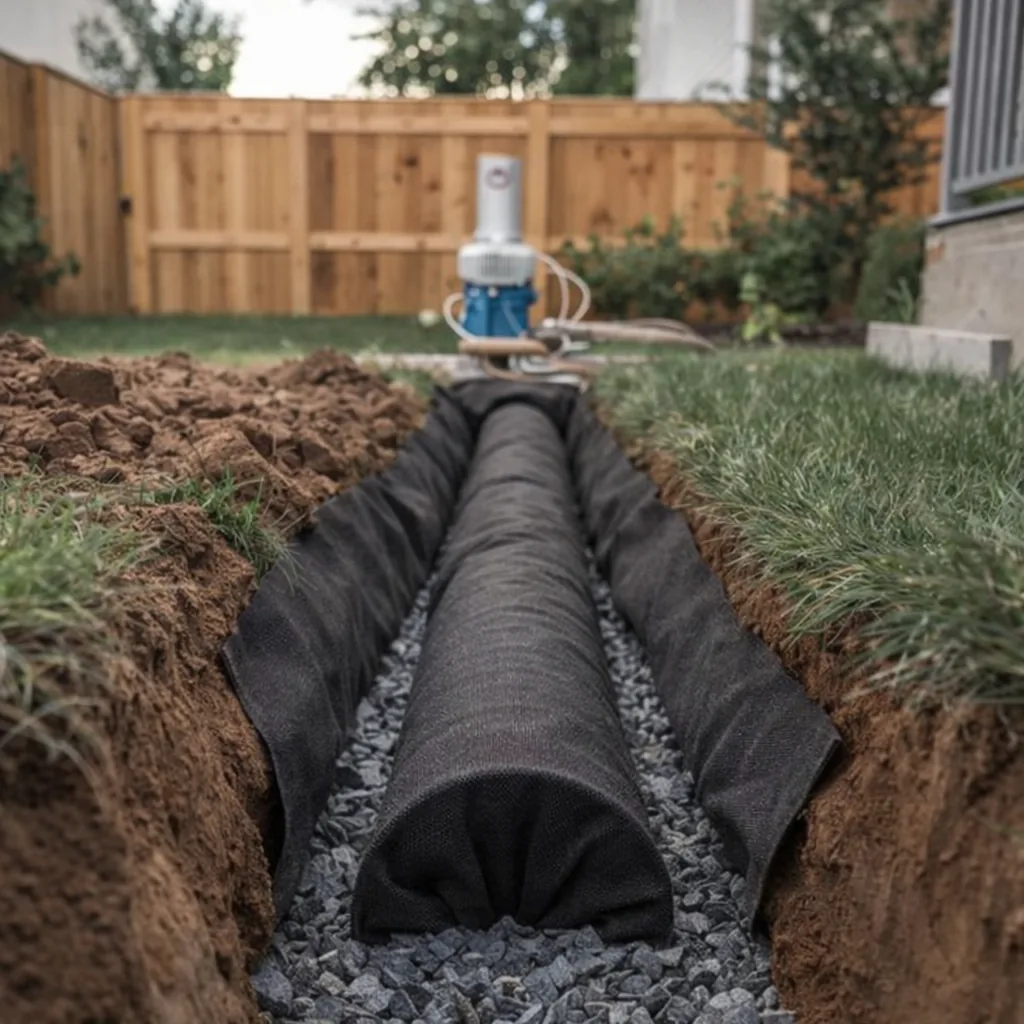
This step decides how long the drain lasts. Lay non-woven geotextile in the trench, into the bottom corners and up both sides, with enough extra to fold over and overlap. Where two runs meet, overlap generously so soil can't slip through.
Step 5: Add a gravel bed
Spread 2 to 3 inches of clean, washed drainage gravel on the fabric. Dirty gravel brings fines that clog the drain from the inside.
Step 6: Lay the perforated pipe
Set 4 inch perforated pipe on the gravel bed, keeping your slope. Many installers face the holes down so water enters as it rises from below.
Step 7: Fill with gravel
Cover the pipe with more clean gravel, leaving a few inches at the top for a soil or stone cap.
Step 8: Fold the fabric over
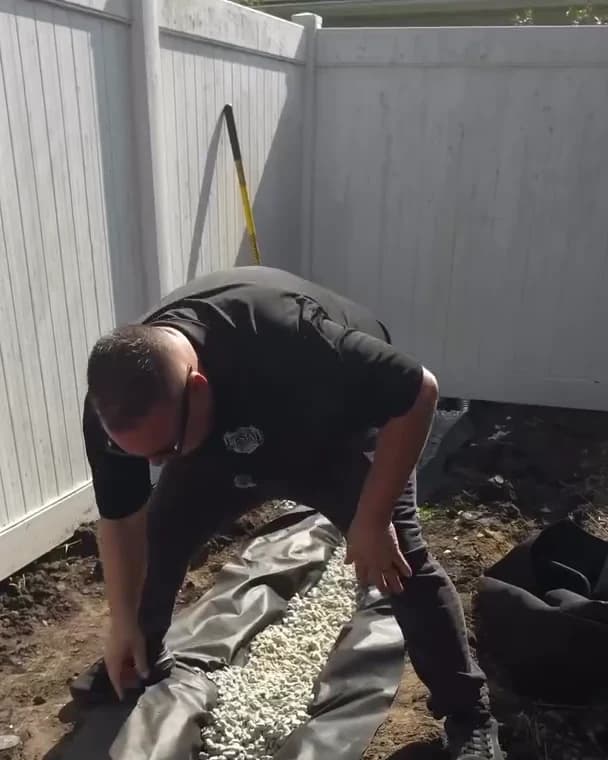
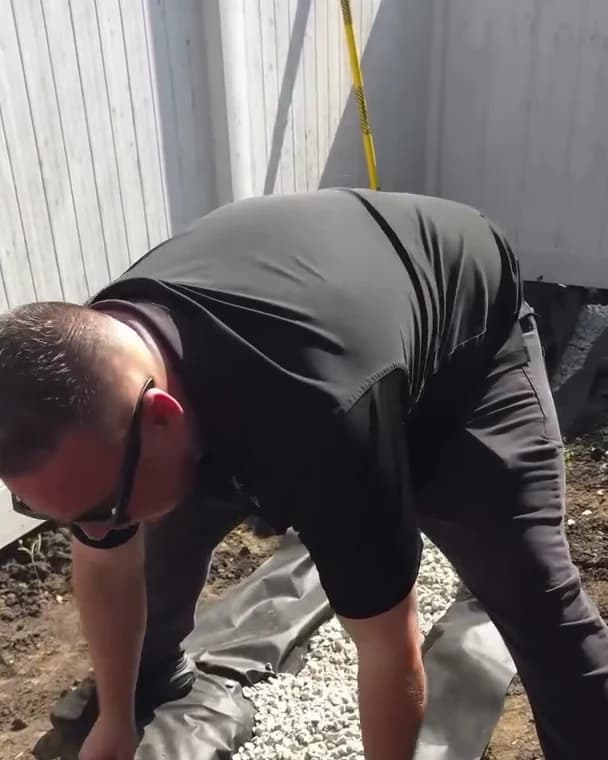
Fold both sides of the fabric over the gravel so they overlap. This keeps topsoil from washing into the stone.
Step 9: Cap and restore
Finish with soil and sod, or with decorative stone if you also want the drain to catch surface water. Run a hose into the high end to confirm flow.
Should you wrap the pipe, the trench, or both?
- Wrap the whole trench (most common): a "burrito" of fabric around the gravel and pipe. The stone zone stays clean and the large filter area clogs slowly. This is what we recommend.
- Pipe sock only: a sleeve over the pipe. It can work in sandy soil, but in silt and clay fines collect at a small filter and the gravel has no protection.
For a closer look at the filter layer, see our French drain fabric page.
Common French drain installation mistakes
- No fall or a belly in the pipe. Water sits instead of moving.
- No outlet plan. A drain that ends in a dead end just fills up.
- Dirty or undersized gravel. Fines clog the system.
- Woven fabric as the filter. Use non-woven; our guide to woven vs non-woven landscape fabric explains why.
- Skipping the fold-over. Topsoil washes into the stone from above.
Water building up behind a wall instead? See retaining wall fabric.
How much geotextile does your job need?
Use the DOTDAY Fabric Calculator to handle the overlap and roll math for your trench or wall.
What we recommend
For French drain installation, we recommend DOTDAY TERRA, a non-woven needle-punched geotextile. It lets water into the gravel while holding soil back, and it drapes into the trench instead of bridging corners.
- 4 oz: light drainage and shallow yard drains.
- 6 oz: standard for most residential French drains (400 lb CBR puncture and 4,000 l/min/m² water flow on the TDS).
- 8 oz: sharp stone or heavy compaction.
Wrong geotextile, drainage failure: TERRA 4 vs 6 vs 8 oz
How TERRA weight changes with stone size and load.
DOTDAY doesn't sell pipe, socks, or gravel. TERRA is the filter layer around the stone and pipe you buy locally. Size it with the Fabric Calculator (trench bottom plus sides plus top overlap). Contractors can request bulk pricing.
Wrapping up
French drain installation cost is mostly gravel, pipe, fabric and labor choice. The install still needs a planned outlet, steady slope, clean gravel and a fabric-wrapped trench. DOTDAY TERRA is the filter layer that keeps soil out of the stone.
TERRA nonwoven geotextile for drainage and separation
Needle-punched nonwoven geotextile for French drains, walls, and base separation. Check the product page for the sizes in stock today.
Shop TERRAThree fabrics. One simple rule.
Use the right fabric for the right ground condition.
TERRA
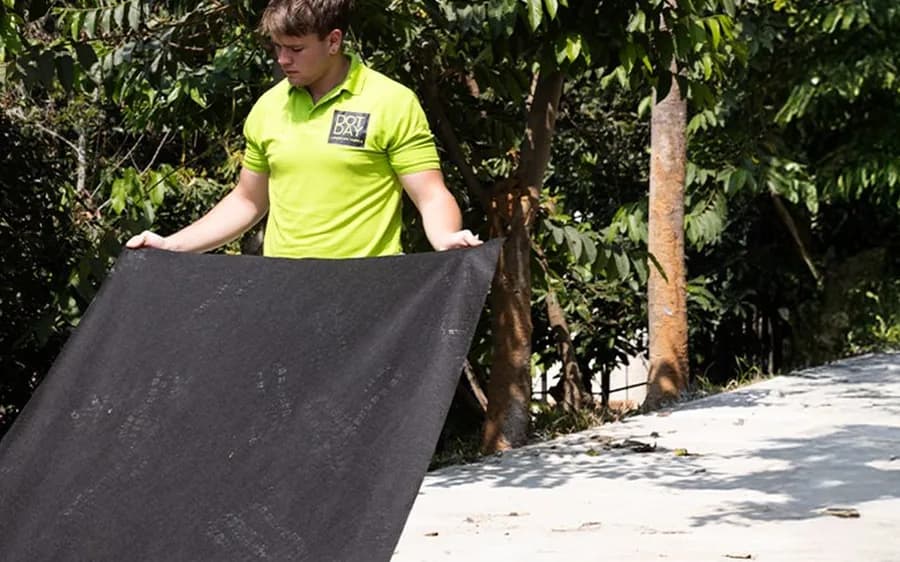
Non-woven geotextile designed for drainage, filtration, and soil separation.
SHIELD
Woven polypropylene weed barrier built to suppress weeds while letting water and air through.
XBAR
Heavy-duty woven hybrid engineered for load and separation under hard surfaces.